Is security awareness training mandatory? The laws and standards in 2026
CyberPulse · Last updated: 15 November 2026
At a glance
There is no universal training duty for every business. A duty can follow from legislation, a standard or your contracts. Identify the framework first, then organise training and evidence around its requirements.
The Dutch Cybersecurity Act, DORA, BIO2, NEN 7510 and ISO 27001 ask for different things. This guide helps you find the relevant route without reading every legal provision separately.
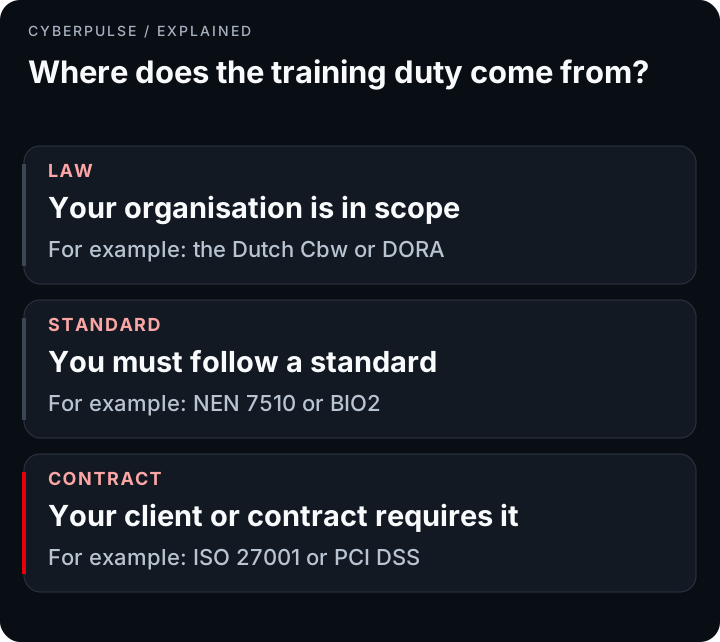
Where does the obligation come from?
A standard can also be embedded in legislation or incorporated into a contract. The routes can overlap: a Dutch healthcare provider may have obligations under NEN 7510, the GDPR and the Dutch Cybersecurity Act.
Which laws and standards apply to you?
The Dutch Cybersecurity Act and NIS2
The Cyberbeveiligingswet (Cbw) has applied in the Netherlands since 15 August 2026. Its duty of care includes cyber hygiene and cybersecurity training. Executive management body members have an additional training obligation with a certificate.
The act covers around 8,000 organisations in 18 sectors. Consider sector, size, linked enterprises and exceptions. The usual size threshold is 50 or more FTE, or both annual turnover and balance sheet total above €10 million. Certain categories are covered regardless of size. Use the NCSC scope check for your situation.
Read more: Dutch Cbw training requirements, staff training and management training. Other EU countries implement NIS2 through their own legislation.
DORA: financial services
Since 17 January 2025, financial entities within DORA’s scope must include security awareness and digital operational resilience training as compulsory training modules. Article 13(6) covers all employees and senior management, with complexity appropriate to their functions. Check the exceptions in Article 2; not every financial office or ICT supplier automatically has the same obligations.
Read more: DORA security awareness training.
BIO2: Dutch government and contractors
BIO2 control 6.03.02 requires employees and contractors using information systems and services to have demonstrably completed information security awareness training successfully within three months of joining. Regular training and management support also matter. Suppliers encounter relevant requirements through their government contracts.
Read more: BIO2 awareness training.
NEN 7510: Dutch healthcare
The Dutch health inspectorate, IGJ, expects healthcare providers to demonstrate that they work according to NEN 7510. Awareness is part of that standard. An organisational certificate is not legally mandatory; a functioning management system and regular independent assessments are. IGJ specifies an assessment at least once every three years.
Read more: NEN 7510 awareness training.
GDPR: appropriate measures
The GDPR does not prescribe a particular course or training frequency. Article 32 requires appropriate security measures; instruction and training can form part of these. Under Article 39(1)(b), the DPO monitors awareness and training among other compliance activities. Base your approach on the risks of your data processing.
Read more: GDPR and security awareness.
ISO 27001 and contractual requirements
ISO 27001 addresses competence (7.2), awareness (7.3) and awareness training (Annex A 6.3). Justify the applicability of controls within your ISMS. Clients may require certification through contracts.
PCI DSS is a contractual standard for card data. Relevant training requirements in 12.6 include a formal programme, training upon hire and at least annually, and coverage of phishing and social engineering. The requirements you demonstrate also depend on your assessment route.
SOC 2 and TISAX can also drive training evidence requirements. Cyber Essentials does not itself require awareness training. CIS Controls and NIST CSF provide useful guidance; they are not automatically legal obligations.
Read more: ISO 27001 and PCI DSS.
What evidence should you keep?
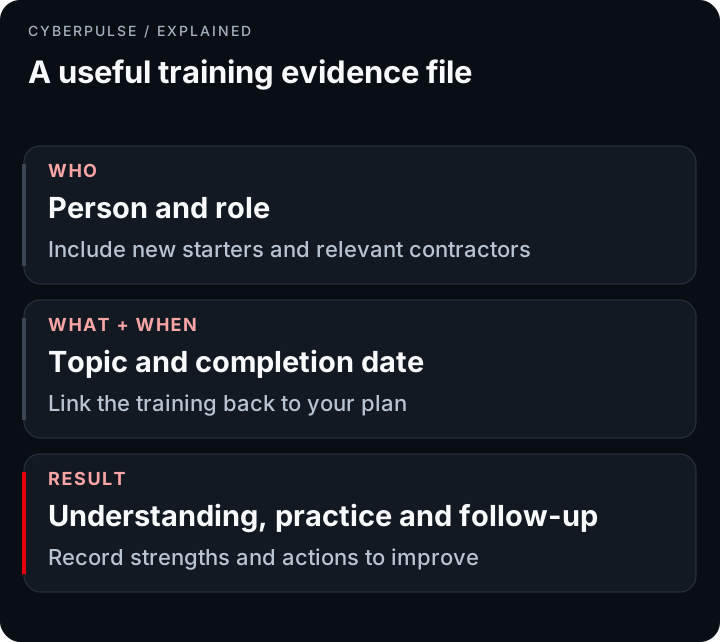
Keep your training plan, individual records and results relevant to your objectives. Add certificates where required. Quizzes and exercises can help demonstrate understanding; simulations are one way to practise behaviour.
Check coverage: new starters, relevant contractors and management are easy to miss. Record improvements made after reviewing the results.
How to get started
- Identify your frameworks. List legislation, standards and client agreements.
- Choose audiences and content. Receptionists, administrators and directors face different risks.
- Arrange onboarding and repetition. Follow explicit deadlines where applicable; justify your own rhythm elsewhere.
- Record delivery and results. Cover the full relevant period.
- Review. Adapt after incidents, role changes and new threats.
CyberPulse supports short weekly lessons, quizzes, phishing simulations and individual reporting. This helps build training evidence; full compliance also depends on your policies, technology and processes. Find a partner or explore the partner model.
Frequently asked questions
Is security awareness training required by law?
It depends on your organisation. The Dutch Cbw and DORA include training duties, while standards and contracts can also require training. The GDPR does not prescribe a particular course.
Who does the Dutch Cybersecurity Act apply to?
Check sector, size, linked enterprises and exceptions. The usual threshold is 50 or more FTE, or both turnover and balance sheet total above €10 million. Use the official NCSC scope check.
What is the difference between NIS2 and the Cbw?
NIS2 is the EU directive. The Cbw implements it in the Netherlands and has applied since 15 August 2026. Other EU countries have their own national implementation.
Is an annual e-learning enough for ISO 27001?
Not automatically. Justify content and frequency through risks, roles and regular updates. Include starters and changes, and retain appropriate evidence of competence and awareness.
Do I have to be able to prove training took place?
Where a framework requires evidence, demonstrate delivery. Retain plans, participation, completion and relevant individual results. Add certificates where required.
What does non-compliance cost?
Consequences vary by framework and infringement: enforcement, audit findings or contractual action. Missing training does not automatically trigger a fixed fine or personal liability.
Sources
- Dutch government, Cybersecurity Act in force from 15 August 2026
- EUR-Lex, NIS2 Directive (EU) 2022/2555
- EUR-Lex, DORA Regulation (EU) 2022/2554
- Wetten.overheid.nl, BIO2 circular (BWBR0052376)
- NCTV, management accountability and training obligations
- EUR-Lex, GDPR, Regulation (EU) 2016/679
- IGJ, questions about NEN 7510
- NCSC, scope of the Dutch Cybersecurity Act
You get CyberPulse through a partner: find a partner · MSP or IT partner? See the partner programme