Dutch Cybersecurity Act: the training requirements that apply in 2026
CyberPulse · Last updated: 15 November 2026
At a glance
If your organisation falls under the Dutch Cybersecurity Act, staff training forms part of the duty of care. Executive management body members also need training with a certificate. Keep individual evidence for both tracks.
The Cyberbeveiligingswet (Cbw) has implemented NIS2 in the Netherlands since 15 August 2026. Training is one part of a broader security programme. These Dutch requirements should not be treated as identical to every other EU country’s implementation.
Is your organisation in scope?
Check sector and size first. The Cbw covers 18 sectors and around 8,000 organisations. The usual size threshold is 50 or more FTE, or both annual turnover and balance sheet total above €10 million. Include partner and linked enterprises where the size rules require it.
Some categories, including certain digital services and government organisations, have no size threshold. Headcount alone therefore cannot settle the question. Use the official NCSC scope check or the NIS2 self-assessment.
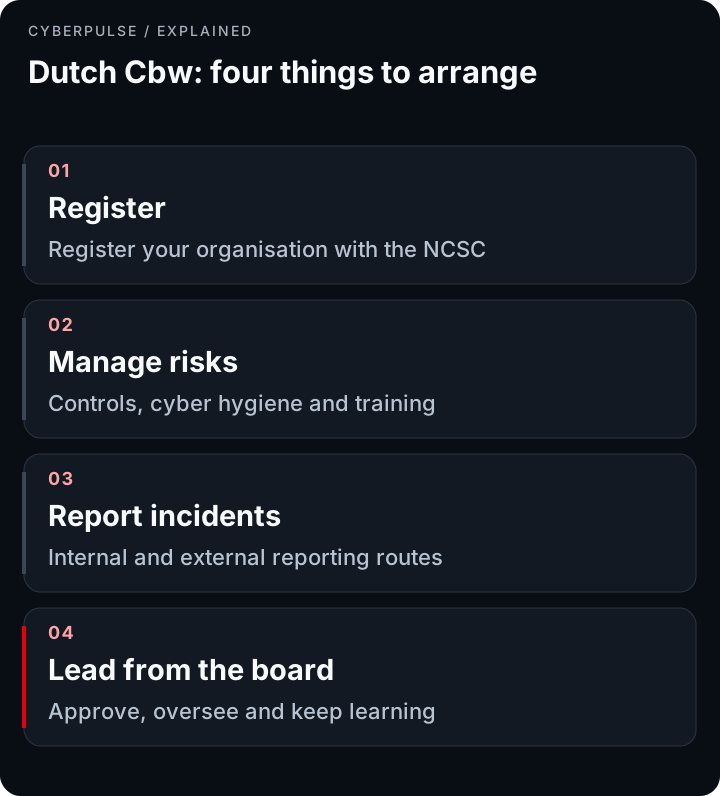
What else do you need to arrange?
- Registration: register the organisation in the NCSC entity register.
- Duty of care: assess risks and apply appropriate controls, including training and cyber hygiene.
- Incident reporting: establish the process for significant incidents.
- Management: approve controls, oversee implementation and maintain the necessary knowledge.
Assign owners and keep evidence for each duty. A training subscription alone does not cover the whole act.
What training do employees need?
The duty of care includes cybersecurity training. It does not prescribe one universal curriculum or frequency for all employees. Select content and repetition that fit your risks.
A practical foundation covers recognising phishing, verifying suspicious requests, using passwords and MFA safely, and reporting incidents promptly. Add role-specific topics: payment fraud for finance, secure administration for IT and safe sharing for people handling client data.
Include training in onboarding and consider relevant contractors. See NIS2 security awareness training for a practical programme.
What applies to executive management?
Article 24 establishes a separate training requirement. Executive management body members must have the required knowledge and skills within two years of the act taking effect, and keep them current. A training certificate is part of the evidence.
The NCTV states that non-executive directors and supervisory board members are outside this specific training duty. Training should address management decisions about cyber risks and controls. A general staff module alone does not adequately demonstrate that level of preparation.
See NIS2 management training for the audience, content and certificate.
What evidence should be ready?
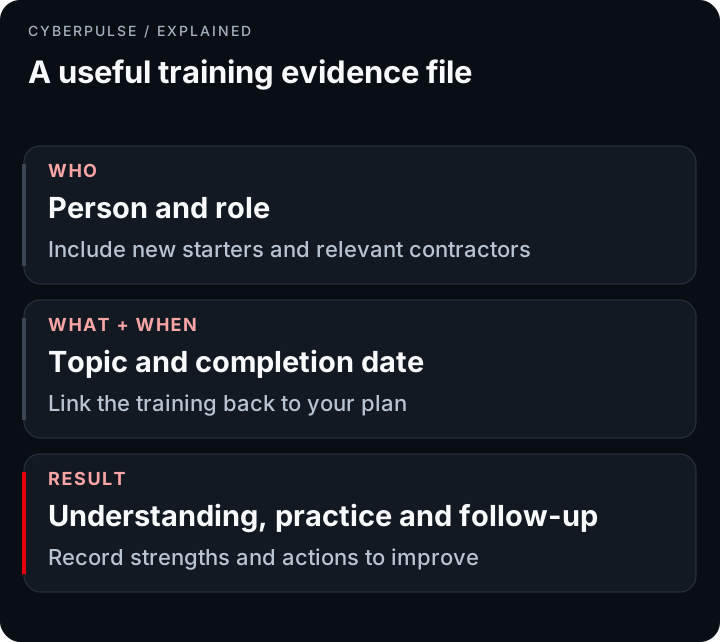
Alongside training records and management certificates, keep your scope assessment, registration confirmation, risk assessment, decisions and reporting procedure. A training report does not replace those documents.
Supervision depends on your sector and classification as an essential or important entity. Non-compliance can lead to enforcement and sanctions; missing a course does not automatically trigger a fixed fine. Document both your decisions and their implementation.
What can you do now?
- Assign responsibility for scope, registration and the evidence file.
- Start an appropriate staff programme and schedule management training separately.
- Record participation, completion and outcomes; follow up gaps.
- Practise the reporting route and have management assess the controls.
- Review whether the approach still fits your organisation.
CyberPulse supports training records with lessons, quizzes, certificates and phishing simulations. Find a partner. For other frameworks, see the overview of training obligations.
Frequently asked questions
My company has 40 employees: does the Dutch Cybersecurity Act affect me?
Possibly. Check sector, linked enterprises and exceptions too. Below 50 FTE, the usual financial size threshold requires both turnover and balance sheet total above €10 million.
When does my organisation have to be registered?
Registration has been required since 15 August 2026 for organisations within scope. Register through MijnNCSC and keep the information current.
What is the difference between NIS2 and the Dutch Cybersecurity Act?
NIS2 is the EU directive; the Cbw implements it in the Netherlands. Use Dutch legislation and official guidance for the applicable national duties and procedures.
Does the Dutch Cybersecurity Act also apply to suppliers?
Not automatically. Assess your own statutory scope. Client contracts may also impose security and training requirements even if your organisation is outside the Cbw.
What has to be in the training?
Choose content based on risks and roles. Cyber hygiene, phishing, secure working and incident reporting are practical subjects. Executive management has a separate training track with certification.
What happens if I do not meet the training requirements?
Non-compliance can lead to supervision, enforcement and sanctions. Consequences depend on classification, infringement and circumstances; missing a course does not automatically trigger a fixed fine.
Sources
- Dutch government, Cybersecurity Act in force from 15 August 2026
- NCSC, the duty of care under the Dutch Cybersecurity Act
- NCTV, management accountability and training obligations
- RDI, Dutch Cybersecurity Act
- EUR-Lex, NIS2 Directive (Directive (EU) 2022/2555)
- NCSC, scope of the Dutch Cybersecurity Act
You get CyberPulse through a partner: find a partner · MSP or IT partner? See the partner programme