NIS2 management training: who, content and certification
CyberPulse · Last updated: 15 November 2026
At a glance
Executive management body members of organisations within the Dutch Cbw must train themselves. They need demonstrable knowledge and skills, supported by a certificate, within two years of the act taking effect, and must keep that knowledge current.
The Dutch Cybersecurity Act has applied since 15 August 2026. Management training supports the responsibility to approve cybersecurity measures and oversee their implementation.
Who must take management training?
The NCTV identifies executive management body members of essential and important entities. Its guidance excludes non-executive directors and supervisory board members from this specific training duty.
Record who the executive management body members are in your organisation. A management job title alone does not decide this. If a particular appointment or governance structure is unclear, check it against official guidance and your legal structure.
Start with the Dutch Cbw requirements if the organisation’s scope is unclear. Employee training is a separate track. Other EU countries have their own national NIS2 implementation.
What should the training teach?
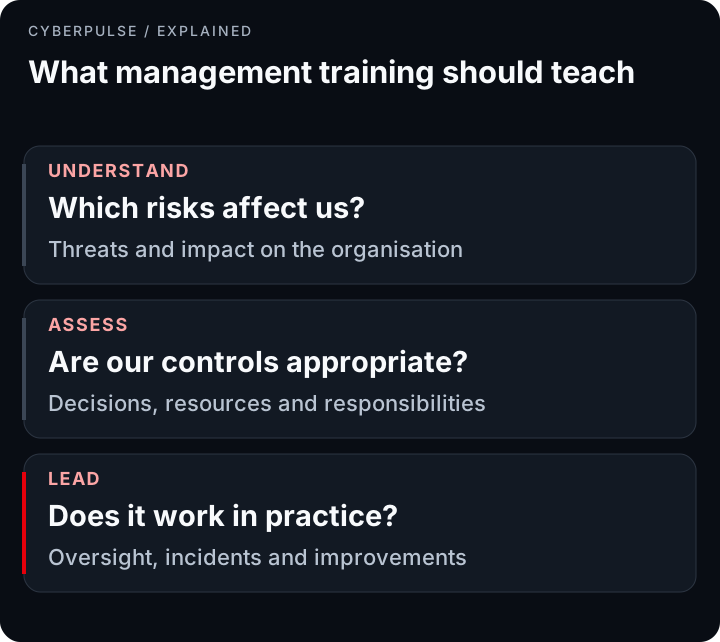
Training covers risks to network and information systems, their potential consequences for the organisation and ways to manage them. Participants need to be able to make informed decisions at management level.
A useful exercise: a supplier is hit by ransomware. Which of your processes stop? Who decides on continuity, communication and reporting? What information do you need from IT before deciding?
This needs different depth from employee phishing awareness. The Dutch government does not prescribe one training provider. An organisation can also arrange training internally, provided it meets the requirements.
When must it be arranged?
The NCTV specifies within two years of the Cbw taking effect. Management’s responsibility to approve measures and oversee implementation already applies in the meantime.
Schedule training in time, keep evidence centrally and include new management body members in your training process. For a new appointment, check the statutory deadline applicable to that person. The initial implementation period is not a reason to stop learning afterwards.
What certificate and evidence should you keep?
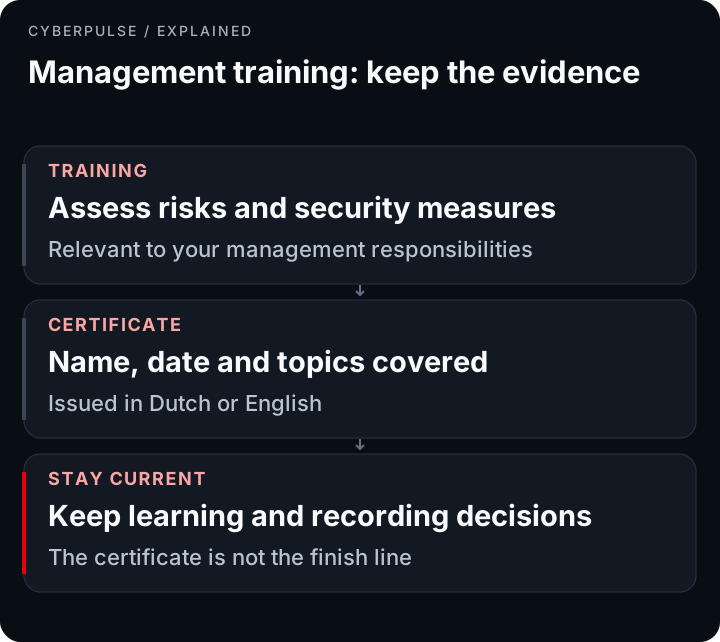
According to the NCTV, the certificate records the training and subjects covered and must be written in Dutch or English. The training itself may be delivered in another language.
Also retain participation, results and further learning. Record management decisions and periodic risk discussions through your governance process. This demonstrates how knowledge informs decisions, without implying that a certificate alone covers the full duty of care.
What happens if you do not comply?
Management remains responsible when implementation is delegated to a CISO or IT partner. NIS2 includes management accountability and enforcement mechanisms, subject to national law and the circumstances. A missing certificate does not automatically establish personal liability or lead to suspension.
Treat training as part of responsible governance: understand risks, make appropriate decisions and oversee implementation.
How to organise it
- Identify the audience. Record the executive management body members in the Cbw entity.
- Choose relevant content. Include risks, controls and management decisions.
- Schedule training and certification. Check what the provider records.
- Keep evidence centrally. Give one owner responsibility for completeness.
- Stay current. Discuss changing risks and incidents at management level.
CyberPulse offers the board training Cyber-resilient leadership for this: eight lessons and a final assessment, with a running case study and questions after each lesson. It records progress and issues a named certificate with a verification code after successful completion. Assess whether its content fits your organisation’s needs. Find a partner who sets it up for you.
Frequently asked questions
By when do I need a certificate as a member of the management body?
The NCTV specifies within two years of the Cbw taking effect on 15 August 2026. Knowledge must remain demonstrably current afterwards. Check the applicable deadline for new appointments.
Does the training obligation also apply to non-executive members?
Not according to current NCTV guidance. The specific training duty applies to executive management body members of essential and important entities, excluding non-executive directors and supervisory board members.
Is ordinary security awareness training enough for the management body?
A general staff module alone does not adequately demonstrate management-level knowledge. Training should address risks, controls and management decisions, with an appropriate certificate.
What do I risk personally if I do not follow the training?
Management has its own responsibilities. Liability and enforcement depend on legal conditions and circumstances. A missing certificate does not automatically establish personal liability or cause suspension.
Does the rest of the organisation need training as well?
Yes. The duty of care also includes cybersecurity training and cyber hygiene for the organisation. Arrange staff training and management training as connected but distinct tracks.
How often does management training have to be repeated?
The cited provisions do not establish a universal repeat interval. Management must keep knowledge demonstrably current; plan updates around risks, changes and incidents.
Sources
- NCTV, management accountability and training obligations
- EUR-Lex, NIS2 Directive (Directive (EU) 2022/2555)
- Dutch government, Dutch Cybersecurity Act in force from 15 August 2026
- RDI, Dutch Cybersecurity Act
You get CyberPulse through a partner: find a partner · MSP or IT partner? See the partner programme