GDPR and security awareness training: what is mandatory in 2026?
CyberPulse · Last updated: 15 November 2026
At a glance
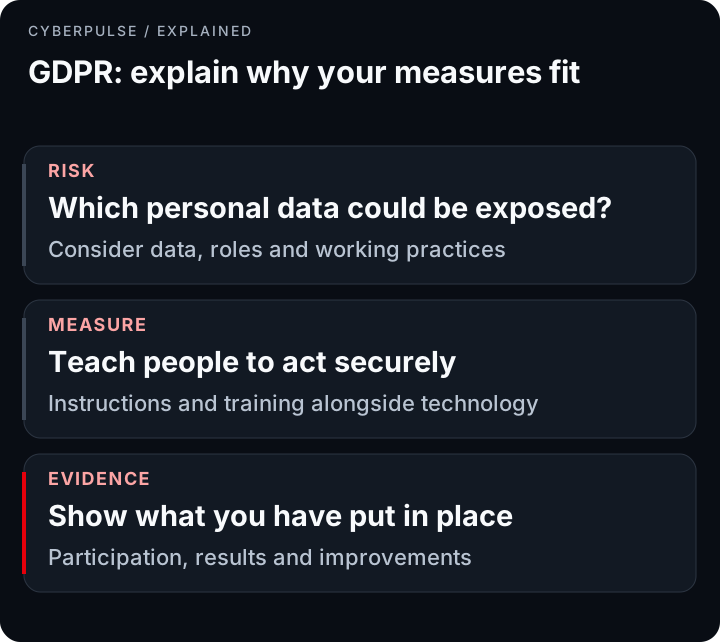
The GDPR does not prescribe a particular awareness course or fixed frequency. It does require appropriate security measures. Explain how instructions and training address your processing risks, and keep evidence of delivery.
The question is not only whether you have a course, but whether people know how to handle personal data responsibly in their actual work.
What does the GDPR say about training?
Three provisions are relevant:
- Article 32: appropriate technical and organisational security measures, taking account of risks.
- Article 32(4): people with access to personal data generally process it only on instructions from the controller or processor.
- Article 39(1)(b): the DPO monitors compliance, including awareness and training for staff involved in processing.
The DPO’s awareness task is therefore in point (b) of Article 39(1). The GDPR does not require a specific commercial training product or say that one certificate establishes full compliance.
How do you decide what is appropriate?
Consider the sensitivity and volume of data, who has access and what could go wrong. Medical information or large client exports may need different depth from a limited address book.
Specify the action you want. “Be careful with email” helps less than “check the recipient and use the approved channel for this document”. Combine training with access controls, secure sharing options and clear procedures.
Standards such as ISO 27001 and, in Dutch healthcare, NEN 7510, can help structure the approach. They do not replace your own GDPR risk assessment.
Which situations should people practise?
- Wrong recipient: check the address and attachment before sending.
- A request for client information: verify identity and authority through a trusted channel.
- Phishing: report the message or mistake promptly through the agreed internal route.
- Working from home: use approved facilities rather than sending an export to personal email.
Teach people when and how to report a possible data breach internally. Employees do not need to conduct the whole legal assessment themselves; prompt reporting gives the responsible team time to assess and act.
What evidence is useful?
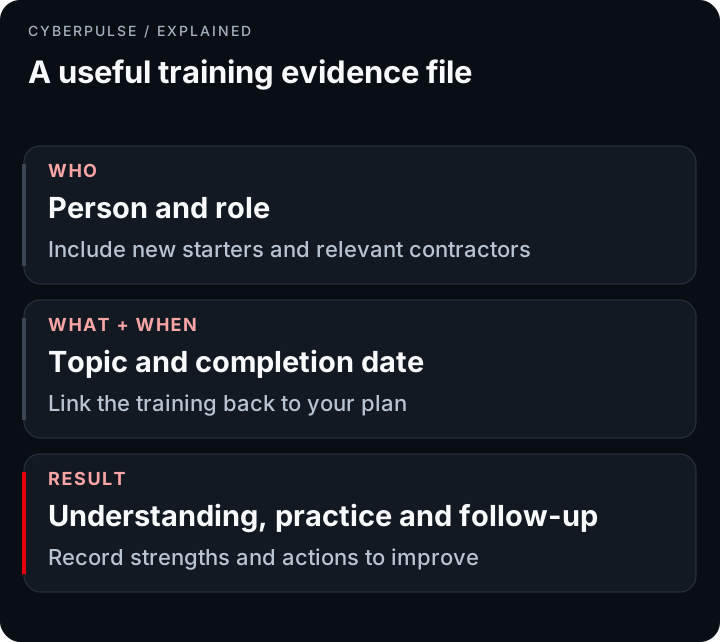
A useful file includes your justification, training plan, records and evaluation. Quizzes and exercises can indicate whether instructions were understood. Attendance can form part of the evidence, but says little about understanding or the effectiveness of the whole programme.
If you have a DPO, involve them in evaluation. Management remains responsible for the measures; the DPO has an independent advisory and monitoring role.
How often should you train?
The GDPR sets no fixed interval. Train during onboarding and provide updates when risks, roles or working practices change. Choose a repeat schedule you can justify and adjust it after incidents or results.
Other frameworks can set explicit deadlines. Check the other training obligations, such as BIO2 or PCI DSS, too.
What happens after a data breach?
A human mistake does not automatically prove security was inadequate. The measures in place and your response still matter. Article 83(4) sets a maximum fine for certain infringements, including security failures, of €10 million or 2% of worldwide annual turnover, whichever is higher. The actual assessment depends on the circumstances.
CyberPulse supports lessons, practice and individual records. Use the results alongside your privacy policies and technical controls. Find a partner.
Frequently asked questions
Is security awareness training mandatory under the GDPR?
The GDPR does not prescribe a particular course. Article 32 requires appropriate security measures, which can include instruction and training. Justify your approach through processing risks.
What does Article 39 mean for our data protection officer?
Article 39(1)(b) includes awareness and training within the DPO’s monitoring duties. Management remains responsible for measures; the DPO advises and monitors independently.
How high can a GDPR fine for inadequate security be?
Article 83(4) sets a maximum for certain infringements, including security failures, of €10 million or 2% of worldwide annual turnover, whichever is higher. The circumstances determine the actual assessment.
How often should I train my employees?
The GDPR sets no fixed frequency. Train when people join and when relevant changes occur; justify repetition through risks, incidents and results.
Does an e-learning with registration count as evidence towards a supervisory authority?
Yes, records can form part of the evidence. Combine them with your reasoning, content, relevant results and evaluation. A certificate alone does not establish full GDPR compliance.
How does this differ from the training requirement under NIS2?
NIS2 explicitly includes cybersecurity training in risk management for organisations in scope. The GDPR requires appropriate personal-data security measures. One programme can support both if appropriately designed.
Sources
- EUR-Lex, GDPR (Regulation (EU) 2016/679)
- EUR-Lex, NIS2 Directive (Directive (EU) 2022/2555)
- Dutch government, Cybersecurity Act in force from 15 August 2026
You get CyberPulse through a partner: find a partner · MSP or IT partner? See the partner programme