ISO 27001 awareness training: what the auditor wants to see in 2026
CyberPulse · Last updated: 15 November 2026
At a glance
ISO 27001 requires competence and awareness. Appropriate awareness training supports both. Record who needs which knowledge, how you develop it and what evidence shows the approach works.
An attendance list tells you who was present. Within your ISMS, you also want to know whether people can carry out their roles securely and understand the information security policy.
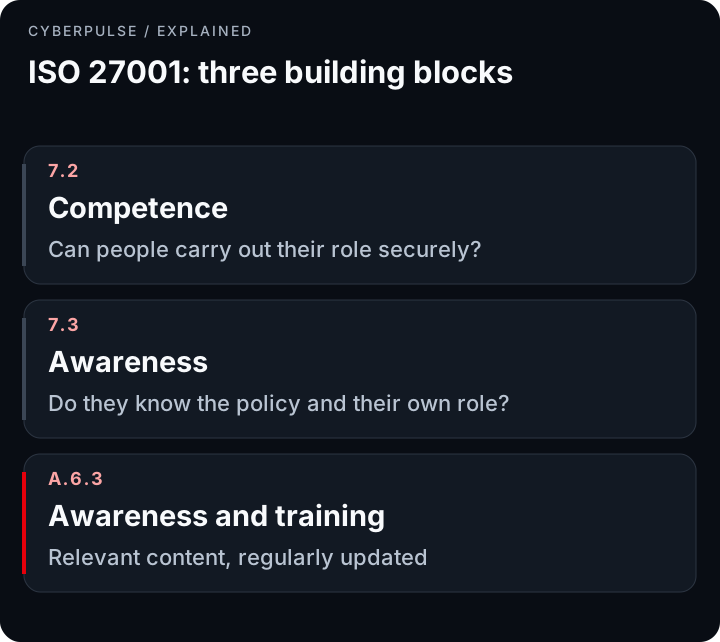
Which parts of ISO 27001 are relevant?
- Clause 7.2 — competence. Identify necessary competence, ensure people have it and retain appropriate evidence.
- Clause 7.3 — awareness. People should understand the policy, their contribution and the implications of non-conformity.
- Annex A 6.3 — awareness, education and training. Appropriate training and regular updates should be relevant to a person’s function.
Document the selection and justification of Annex A controls in your Statement of Applicability. ISO 27002 provides implementation guidance; use it alongside your risk assessment. The official standards are available through ISO or NEN.
ISO 27001 certification is generally a choice or a contractual requirement. Assess other statutory training duties separately.
What should an auditor be able to follow?
A clear chain from risk → learning objective → delivery → outcome. Keep a training plan with audiences, individual records, competence evidence and an evaluation of effectiveness.
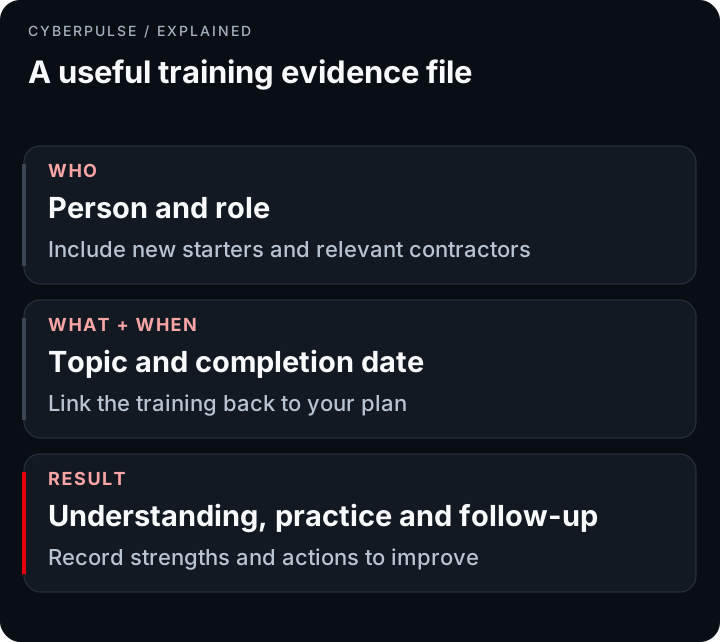
An auditor may review documents, interview staff and take samples. Ensure a recent starter or someone in a specialist role is covered. An average participation percentage alone does not answer an individual sample request.
For a system administrator, a practical exercise may provide relevant competence evidence. For general awareness, quiz results, exercises and discussions can help. A quiz score does not automatically demonstrate every competence needed for a role.
How often should you train?
ISO 27001 does not prescribe a universal annual or monthly awareness frequency. Justify your rhythm through risks and the need for regular updates.
Train when people join and when relevant roles or policies change. Revisit topics with weaker results and include emerging threats. If another applicable framework, such as PCI DSS, sets a concrete deadline, include that too.
A common foundation for everyone can work well. Add depth where functions require it; you do not need an entirely separate course for every employee.
Which mistakes can you avoid?
- Keeping attendance alone. Record what results tell you about understanding or competence.
- Missing starters or contractors. Define the audience and keep it current.
- Ignoring roles. Connect specialist content to real tasks and risks.
- Skipping evaluation. Use findings to improve training and processes.
- Losing evidence. Keep it centrally, with clear ownership and coverage periods.
How to organise it
- Define competence and awareness objectives for relevant roles.
- Document content, audience, frequency and responsibility.
- Record participation and use appropriate methods to assess understanding.
- Include outcomes and improvement actions in your ISMS cycle.
CyberPulse supports training records, quizzes and phishing simulations. Your own specialist learning and ISMS justification remain necessary. Find a partner. For Dutch healthcare, see NEN 7510 awareness training.
Frequently asked questions
Is an annual e-learning module enough for ISO 27001?
It depends on your risks and delivery. The standard does not set a universal annual interval. Include starters, role-specific depth and regular updates, and justify your choice.
Is ISO 27001 certification required by law?
Certification is generally a choice or contract requirement. Assess statutory duties separately; some sectors have specific legal references to standards.
What evidence does an auditor ask for on awareness training?
Examples include the training plan, individual records, appropriate competence evidence and evaluation. Auditors assess these within your ISMS through documents, samples and interviews.
What is the difference between clause 7.2 and 7.3?
Clause 7.2 covers competence needed for the work and appropriate evidence. Clause 7.3 concerns awareness of policy, contribution and the implications of non-conformity.
Do I have to test understanding, or is recording participation enough?
Attendance alone does not automatically demonstrate understanding or competence. Use appropriate assessment, such as questions or exercises. A quiz score does not establish every role-related competence.
Where can I find the text of ISO 27001?
Obtain the official standards through ISO or NEN. ISO 27001 provides requirements, while ISO 27002 provides implementation guidance for controls.
Sources
- ISO, standard page ISO/IEC 27001
- PCI Security Standards Council, document library (PCI DSS v4.0)
- NEN, NEN 7510-1:2024
You get CyberPulse through a partner: find a partner · MSP or IT partner? See the partner programme