DORA security awareness training: what article 13(6) requires in 2026
CyberPulse · Last updated: 15 November 2026
At a glance
For financial entities within DORA’s scope, security awareness and digital operational resilience training are compulsory training components. Everyone participates, including senior management. Complexity should fit the person’s function.
DORA has applied since 17 January 2025. The EU regulation applies directly. Article 13(6) is the basis for staff training.
Who has the training obligation?
DORA addresses the financial entities listed in Article 2, including banks, insurers, payment institutions and investment firms. Its scope includes exceptions and particular regimes. There is no general threshold of 50 employees, but saying every financial office is covered is too broad.
Check your category and any exception. A small office can be in scope, while certain smaller intermediaries may be excluded.
ICT supplier? Providing services to a bank does not automatically make you a financial entity with identical training duties. You may face contractual requirements; DORA also provides oversight of designated critical ICT providers. Financial entities include suppliers in relevant training where appropriate.
What does Article 13(6) require?
Three elements:
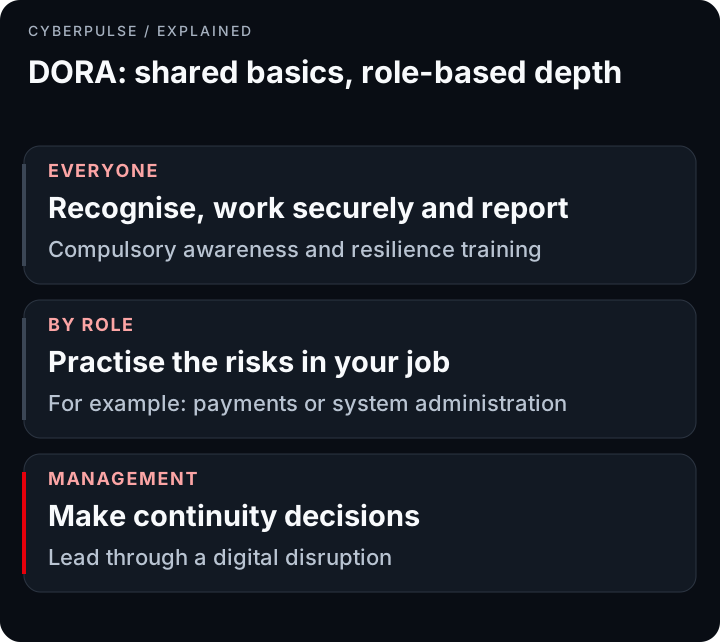
- Compulsory modules. Include ICT security awareness and digital operational resilience in staff training schemes.
- Everyone in the audience. Cover all employees and senior management.
- Depth appropriate to the role. Match complexity to the person’s responsibilities.
This also covers responding to disruption: what happens when systems are unavailable, who decides and how does the organisation maintain responsible service delivery?
How do you make it role-specific?
Use a common foundation for phishing and incident reporting. Add payment-fraud exercises for payment teams, recovery and escalation scenarios for administrators, and continuity decisions for senior management.
Document your reasoning: which groups have you identified and why is their training appropriate? A different job title does not automatically require an entirely separate course; meaningful differences in risks do.
What does management need to do?
Management is responsible for the ICT risk management framework. Article 5(2)(g) includes allocating and periodically reviewing an appropriate budget, including awareness and resilience training. Article 5(4) addresses keeping management’s own knowledge current.
Keep evidence of training choices, budget decisions and management review of results, alongside employee participation.
How often should you train, and what evidence matters?
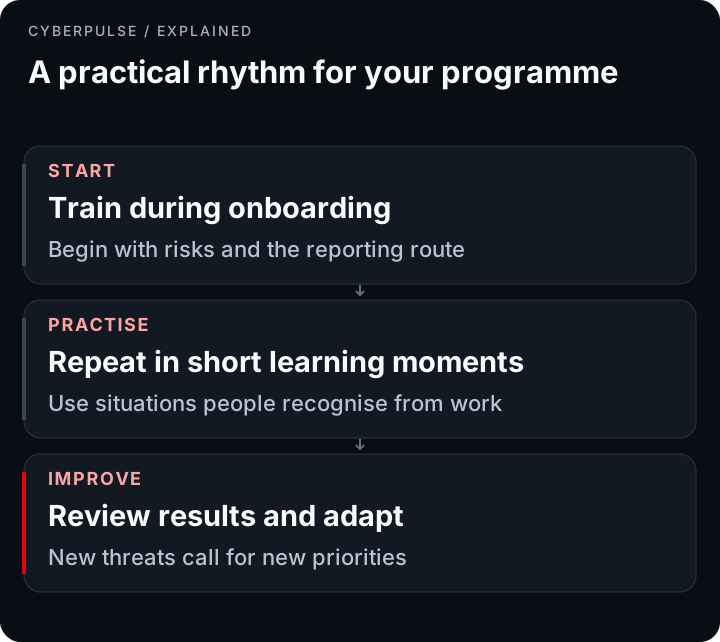
Article 13(6) does not set a universal monthly or annual count. The European supervisory authority EIOPA emphasises an approach that remains current and effective. Include starters, changes and repetition in your plan.
Retain audiences, role-specific content, participation, results and follow-up. Demonstrate that the compulsory components are delivered and evaluate whether people know their responsibilities during disruption.
How does this fit with other frameworks?
DORA operates as sector-specific legislation for overlapping ICT-risk obligations under NIS2. Do not simply add obligations together without assessing the interaction. An ICT supplier may itself fall within the Dutch Cbw; check scope separately.
A shared training file can support ISO 27001 and other frameworks when content and evidence match their requirements. See the overview of training obligations.
CyberPulse supports ongoing awareness and individual records. Add the role-specific resilience and continuity exercises your organisation needs. Find a partner.
Frequently asked questions
Does DORA also apply to small firms?
Small offices can be in scope, but Article 2 includes exceptions and particular regimes. There is no general 50-employee threshold. Check your category and any exemption.
Since when has DORA applied?
DORA has applied since 17 January 2025. It is an EU regulation with direct application, without a separate Dutch implementation act.
Is one annual e-learning enough for DORA?
Not automatically. Article 13(6) requires compulsory awareness and resilience training appropriate to functions. Justify content, rhythm and updates, including starters and changes.
Does senior management have to train too?
Yes. Article 13(6) names all employees and senior management. Article 5 also addresses management knowledge and training budgets.
Does DORA apply to ICT service providers?
ICT suppliers face contractual requirements, and designated critical providers have specific oversight. They are not automatically financial entities with identical training duties. Include them in relevant training where appropriate.
What is the difference between DORA and NIS2?
DORA is a directly applicable sector regulation. NIS2 is a directive implemented nationally. Assess overlap: DORA is sector-specific legislation for overlapping ICT-risk obligations.
Sources
- EUR-Lex, Regulation (EU) 2022/2554 (DORA)
- EUR-Lex, Directive (EU) 2022/2555 (NIS2)
- Dutch government, Cybersecurity Act in force from 15 August 2026
- EIOPA, DORA Article 13(6): training frequency
You get CyberPulse through a partner: find a partner · MSP or IT partner? See the partner programme