PCI DSS security awareness training: requirement 12.6 explained (2026)
CyberPulse · Last updated: 15 November 2026
At a glance
PCI DSS requires a formal awareness programme, with training upon hire and at least annually. Phishing and social engineering must be explicit topics. Confirm with your acquirer which requirements and assessment route apply to your organisation.
PCI DSS is the security standard for card data. Obligations are enforced through card brands and contracts with parties such as your acquirer, which arranges your card acceptance.
Who is this relevant to?
Organisations storing, processing or transmitting cardholder data, and relevant service providers. Examples include online shops, retailers, hospitality businesses and payment processors. Scope and the way you demonstrate compliance vary with your setup.
Outsourcing payments does not remove every responsibility. Agree with your acquirer or assessor which self-assessment or assessment applies. Not every assessment route asks exactly the same questions.
PCI DSS is not legislation. Non-compliance can nevertheless have contractual and commercial consequences. Other laws, such as the GDPR, may also apply.
Which training requirements are in 12.6?
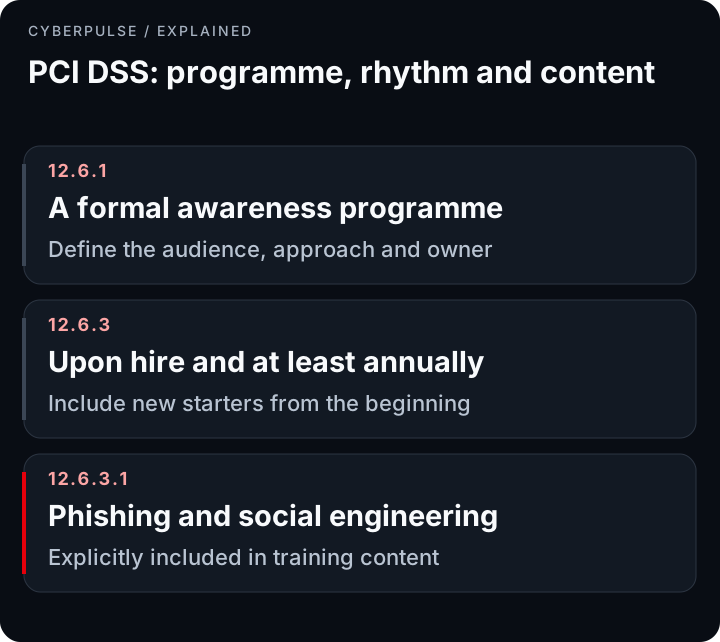
12.6.1 — a formal programme. Describe the audience, subjects, delivery approach and responsible owner. Include all relevant personnel within the established scope, remembering part-time, temporary and newly hired staff.
12.6.3 — upon hire and at least annually. Training belongs in onboarding. Waiting until the next annual campaign can leave a gap. Monitor repeat training for each person, including when staff turnover is high.
12.6.3.1 — phishing and social engineering. These topics have been compulsory since 31 March 2025. Use the current PCI DSS version and check that content addresses threats to the cardholder data environment.
Requirement 12.6 also includes provisions on keeping the programme current and personnel acknowledging policies. The three points above are therefore not a complete PCI DSS checklist.
Are phishing simulations mandatory?
Phishing must be covered, but the training requirement does not prescribe simulations as the only delivery method. Simulations can help people practise recognition and reporting and identify topics for further training.
Include other realistic scenarios: a telephone “helpdesk” asks for access, a supplier unexpectedly changes payment details or someone requests data through an unusual channel. Teach verification and internal reporting.
Technical phishing protection and awareness are separate controls. One does not replace the other.
What evidence should you retain?
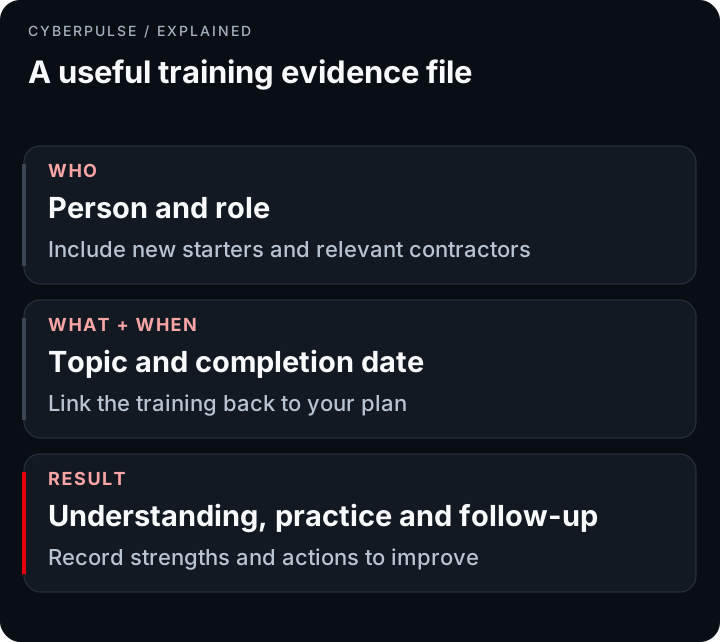
Keep your programme, audience and content versions. Record training upon hire and subsequent repetition for each person. Retain results, required policy acknowledgements and follow-up as applicable to your requirements.
An invoice for a training platform does not prove people participated. A click rate alone does not demonstrate coverage of all required content either.
How to organise it
- Confirm scope. Agree it with your acquirer or assessor.
- Document the programme. Define audience, content, ownership and repetition.
- Connect training to hiring. Include temporary staff too.
- Monitor repetition and currency. Check deadlines and emerging threats.
- Keep the evidence. Make delivery and follow-up traceable by period.
CyberPulse supports short lessons, quizzes, phishing simulations and records. Combine these with your card-data policies and applicable PCI DSS procedures. Find a partner. Compare the approach for ISO 27001.
Frequently asked questions
Is PCI DSS security awareness training a legal requirement?
PCI DSS is not legislation. Obligations arise through card brands and contracts with parties such as your acquirer. Other laws, including the GDPR, can also apply.
How often does PCI DSS require you to train personnel?
Requirement 12.6.3 calls for training upon hire and at least annually. Monitor both for each person and check your scope and assessment route.
Does phishing have to be part of the training?
Yes. Requirement 12.6.3.1 covers phishing and social engineering and has been compulsory since 31 March 2025. Check that current content addresses relevant threats.
Who has to complete the PCI DSS awareness training?
Include all relevant personnel within the established scope, including temporary staff, part-timers and starters. Confirm scope and the assessment route with your acquirer or assessor.
What do you risk if you do not meet requirement 12.6?
Consequences arise through card brands and contractual relationships, such as your acquirer agreement. They vary by situation; PCI DSS does not impose one uniform government fine.
Are phishing simulations mandatory under PCI DSS?
The requirement specifies coverage of phishing and social engineering, not simulations as the sole method. Simulations can support practice; technical controls and other training remain necessary.
Sources
- PCI Security Standards Council, document library (PCI DSS v4.0)
- EUR-Lex, Regulation (EU) 2016/679 (GDPR)
- Dutch government, Cybersecurity Act in force from 15 August 2026
You get CyberPulse through a partner: find a partner · MSP or IT partner? See the partner programme